-
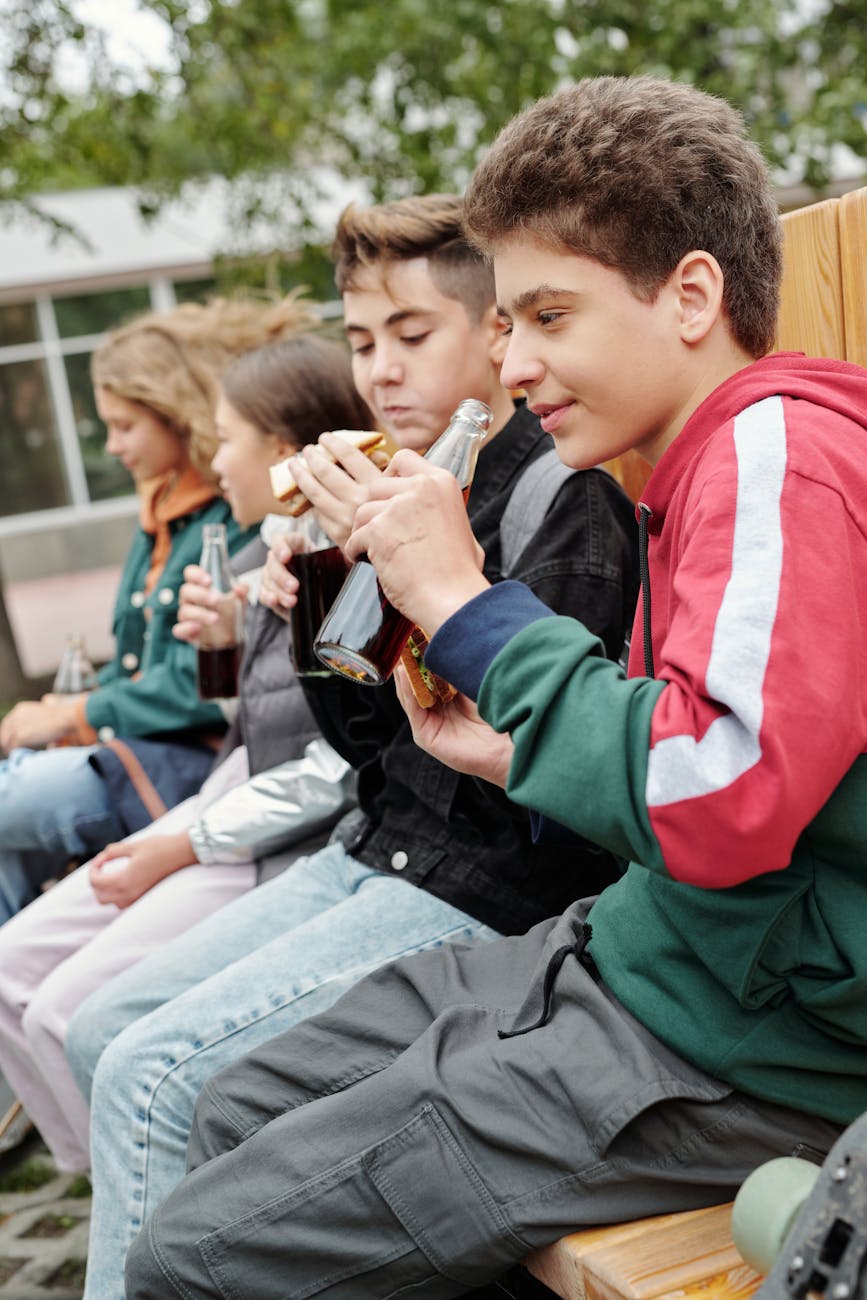
Photo by Max Fischer on Pexels.com
Let’s Address the Elephant in the Room… Alcohol abuse in minors can be a scary topic to talk about, but in this day and age, it’s a very common activity that takes place. Strong influences, such as peer pressure, stress, and social media can immensely impact how often a child will drink. As a parent, you only want what’s best for your child, and as a young adolescent, you only want to cope knowing the best way you know how. There are many reasons why a teenager would want to drink alcohol, despite it being an illegal activity. During this stage of life, puberty has already taken place, and teenagers are developing their own sense of identity. Even though adolescents obtain some concept of who they are based on their family relations and how safe they feel at home, they mainly and emotionally depend on their peers once they reach the age of 11 to 14 years old (Broderick & Blewitt, 2024). Adolescents can relate to their peers if they share a bond over their loneliness and the stressful events that may have happened in their past or present moment. Because of this, teenagers tend to compare themselves to others at school and they try to develop their own sense of identity by matching how others behave, as well. It has been found that teenage anxiety and depression rates have grown within the past two decades because of social media use. Teenagers can compare how well their lives are with other peers online. Cyberbullying tends to take place, too, after teens share statuses or pictures about themselves online. All these factors, along with the stresses of submitting homework on time, partaking in extracurricular activities after school, handling family responsibilities, partying with friends, and more can also impact the chances of teenagers partaking in alcohol use. Alcohol is the most common drug used by people under the age of 21 in the United States (Centers for Disease, 2025). With this in mind, it is important to understand how you can prevent this type of activity from happening. Whether you are a parent or a teen, you have a responsibility to understand how this can be helped.
What You Can Do…
Dear Adolescents,
It’s understandable you want to hang out with friends and drink as a way to connect with them. However, only hanging out with one group of friends that do this can lead to serious consequences (such as jail time). It’s much more fun to hang out with friends that do activities that are more enjoyable to you (like basketball). Not only is obtaining a new hobby that you enjoy doing better for your mental health, but obtaining more friends from various backgrounds helps prevent you from doing more dangerous activities, such as drinking (Wang et al., 2025).
Partaking in a hobby would be more beneficial for you to do in the long run. For example, if you always wanted to paint in your free time, it may be wise to join a painting club at school with other classmates who love to paint, or to start painting at home instead of drinking and drive with friends on a Saturday night. Painting, for example, would allow you to reach a creative or ‘flow’ state, which brings you a better sense of accomplishment than drinking alcohol.
There are also other resources that are listed down below that can help assist you with getting out of a rut.

Attached to this column is a Ted Talk video, and in it, Megan Hanley speaks about her struggles with alcohol abuse and how she overcame it (Hanley, 2017).
Parents, You Can Help…
Whether you realize it or not, you can make an impact on how your child will cope with their situation. It can be very easy for parents to want to be there for their child and try to advise them on all the different ways they can seek help. It’s important for a family system to establish rules and guidelines to support this type of behavior. While it is important to consider seeking out family related therapy sessions with your child, it is also beneficial for individual family members to consider seeking out their own type of therapy and obtain help for how they struggle to communicate and behave in the family (Brooks & McHenry, 2014). It is important to think about where the addiction lies in your family, and where your child may be getting their drinking habits from. There may be other stressful topics that have been talked or argued about in the family that may trigger your child’s drinking habits. Consider, too, what your child’s personality is and how well they communicate with your family members (Brooks & McHenry, 2014).
It’s important to consider how much input you put into your child’s activities. There can be too much emphasize on trying to control their behavior, and not enough emphasize on enforcing positive communication with them (Zhiyong & Schaninger, 2010). It’s important to remain openminded and nonjudgemental about your child’s behavior, even if you want to tell them how bad drinking is for them. It is also crucial to understand what your environment is like at home. If you stock alcohol in your cupboards, you may be unintentionally encouraging your child to drink when you are not at home (Nguyen, 2026). It would be beneficial to display more productive behaviors around your child, as well. For example, deciding to go outside more often or obtaining a fun hobby at home may inspire your child to do the same.
It has been found in one study that parents who display positive expectations and rules about drinking alcohol are three times more likely to intervene with their teen and communicate more effectively with them (Wang-Schweig et al., 2025). It’s important to acknowledge your child’s drinking around them, but not in a negative light.

Friends and Teachers…
You already know about the social norms that surround adolescent drinking. Whether you are a friend or teacher, you understand that peer pressure comes with a price. However, you have a chance to prevent this from happening. One study found that friends who disapprove drinking, often enforce positive experiences and cancels out drinking altogether (Lim et al., 2026). As a friend, you can take a step in the right direction and not drink with your friends because you have that right. This may encourage your other friends to follow the law and to not drink, as well. The younger you are with your friend, the more easily you can persuade your friend to drink (Caluda-Perdue et al., 2025). The quality of your friendship also matters, and if you built a strong relationship with your friend, it’s very likely they will follow along with what you want to do, too. This is how much influence you can have over your friends, and that is why it is very important to try to lead them in the right direction. Playing video games for hours on end together may be a better use of your time instead of drinking, which can lead to more negative psychological and physical effects on the human body.
Teachers, you can make an impact in your community by implementing an alcohol use prevention curriculum into your plan (Pankratz et al., 2006). It is possible for you to change your schedule, and this would be the best way to do it. Not only would you be productively displaying helpful information about alcohol use, but you would also be positively encouraging your students not to drink alcohol in a passive way.

To help teens thrive and live their life to the fullest!
- Growtherapy.com aims to help children and teenagers cope with their current struggles. Not only are their premiums cheap, but they offer remote therapy services, which, in this day and age, can be very enticing to adolescents who spend their time online anyway (Therapy Near You, n.d.)
- Depending on how serious the situation is, partaking in a support group may not be such a bad idea. There are organizations, such as Alcoholics Anonymous (Have a Problem, n.d.) The New Hampshire Teen Addiction Hotline is also readily available to take any calls 24/7. They provide additional resources to help teens connect with others and receive the help they need (New Hampshire, n.d.)
- There are youth and drug services that offer programs that adolescents can attend any time. There are walk in centers and programs at rehabilitation centers that offer support. Seeking a doctor may be helpful for those who are struggling with their symptoms and need additional referrals.
- Obtaining additional medication may be suitable for the adolescent, depending on how serious the addiction is. Additional medication, such as SSRI’s, may be helpful to treat teenagers who may be experiencing anxiety and depression symptoms that can lead to drinking more excessively.
- Broderick, P. C., & Blewitt, P. (2024). The Life Span: Human Development for Helping Professionals (6th ed.). Pearson Education (US).
- Brooks, F., & McHenry, B. (2014). A contemporary approach to substance use disorders and addiction counseling. American Counseling Association.
- Centers for Disease Control and Prevention. (2025, January 14). About Underage Drinking. Centers for Disease Control and Prevention.
- Caluda-Perdue, N. J., Schwartz-Mette, R. A., & Colder, C. R. (2025). Intimacy-driven conformity: A between- and within-person perspective on friendship quality and adolescent susceptibility to peer norms about alcohol. Alcohol, Clinical & Experimental Research, 49(11), 2567–2578.
- Hanley, M. (2017). Alcoholism and Drug Abuse in Teenagers. YouTube.
- Have a Problem with Alcohol? There is a Solution. Alcoholics Anonymous. (n.d.).
- Lim, N., Kennelly, N., Chung, T., Powell, M. Z., Latendresse, S. J., & Sartor, C. E. (2026). Associations between alcohol-related parenting factors and youth alcohol expectancies: considering the role of perceived friends’ disapproval of alcohol use. Alcohol and Alcoholism (Oxford, Oxfordshire), 61(3).
- New Hampshire Teen Addiction Hotline. Teen Addiction Hotline Adolescent Helpline. (n.d.).
- Nguyen, H. V. (2026). Audience Interpretation of Risks in Health Promotion Campaigns About Underage Drinking: Qualitative Interviews With Parents of Adolescents. Health Promotion Journal of Australia : Official Journal of Australian Association of Health Promotion Professionals, 37(3), e70184.
- Pankratz, M. M., Jackson-Newsom, J., Giles, S. M., Ringwalt, C. L., Bliss, K., & Bell, M. L. (2006). Implementation fidelity in a teacher-led alcohol use prevention curriculum. Journal of Drug Education, 36(4), 317–333.
- Therapy Near You & Online Therapy that Takes Your Insurance. growtherapy. (n.d.).
- Wang-Schweig, M., Miller, B. A., Byrnes, H. F., & Rogers, V. (2025). Parent and teen engagement in smart choices 4 teens to address teen alcohol use and relationships. Journal of Child and Family Studies, 34(6), 1417–1432.
- Wang, J., Yu, J., Du, X., Yin, C., Zhang, Z., Duan, Y., & Chen, R. (2025). Understanding Social Influence of Non-Suicidal Self-Injury: The Interplay of Peer Networks and Adolescent Behavior. Journal of Youth & Adolescence, 54(8), 2035–2048.
- Zhiyong Yang, & Schaninger, C. M. (2010). Parenting Strategies as Influences of Teen Drinking via Self Esteem: An Important Area for Family Policy. Journal of Macromarketing, 30(4), 331–341.
 Overcoming Alcohol Abuse in Adolescents